Family history can, and should be found around our own homes. Your house is a great place to look for clues as well as the ideal place to display what you’ve already found! In this free genealogy live webinar Lisa Louise Cooke will show you how.
Elevenses with Lisa Episode 65
In Elevenses with Lisa episode 65 Lisa Louise Cooke will:
explore our homes for family history
see if we can’t unlock some mysteries, and
look at some fun and creative ways to incorporate family history into our homes!
Episode 65 Show Notes
Watch episode 65
Home is where the heart is and it’s certainly where the family history is. If you’ve found an interesting piece of family history around your home tell us about in the Comments section below so we can all get more ideas of what to look for.
What To Do with the Family China Nobody Wants
Author Robbie Shell wrote an article for the Wall Street Journal calledThe Family Heirlooms That Our Children Don’t WantLifelong possessions look very different when we start trying to pass them on.
She wrote about being retired and becoming a grandmother. “The new baby (my first grandchild) and new house ignited one of my long-awaited projects—excavating crawl spaces and basement corners on a hunt for possessions to pass on to the next two generations. It’s easy to predict how this played out. My son and his wife turned down many more items than they accepted. Much of what I had hoped to “upsize” to them stayed in my basement and attic. What wasn’t easy to predict, however, was how complicated this seemingly simple transaction could be. It involved multiple perspectives, across multiple generations. It showed how possessions, when held up to the light, often lose the very qualities that prompted us to set them aside. And, in my case, it offered a glimpse of a future that I’ve thought about—and looked forward to—for years.”
She proceeds to describe how she went through items in the house, offering them up to her son and daughter-in-law. She got replies like:
Too ornate
No Shelf space now, maybe later,
“They did give thumbs-up to desk lamps, guest sheets and towels, a few kitchen items and one folding chair, among other things—utilitarian items with no stories or expectations attached.”
It’s an interesting dilemma I hadn’t thought about when I was carefully collecting and saving things over the past few decades: that being attached to the story behind the item was key to valuing it. We’re attached. They aren’t.
Then of course if enough years and even generations go by, we develop an interest in family history and can’t believe our good fortune to unearth such a treasure.
“Then there was the collection of unrelated items I now saw in a different light—those whose stories matter only to me: the child’s battered wooden rocking chair from the porch of my grandparents’ summer house; a faded, inscribed photograph of my father as a young man standing next to his own father, whom I never met; and the small tarnished music box with a twirling ballerina on top that was a gift from my godfather when I was young enough to still dream about being a dancer.
These things will stay with me here in the home where I have lived for decades.
Unless…
One day a young girl visiting her grandparents comes upon the music box. She picks it up and turns the key that starts the music playing. “Grandma,” she says, “what’s this? Can I have it?” “It’s yours,” I say, my heart skipping a beat. “It always has been. You had only to ask.”
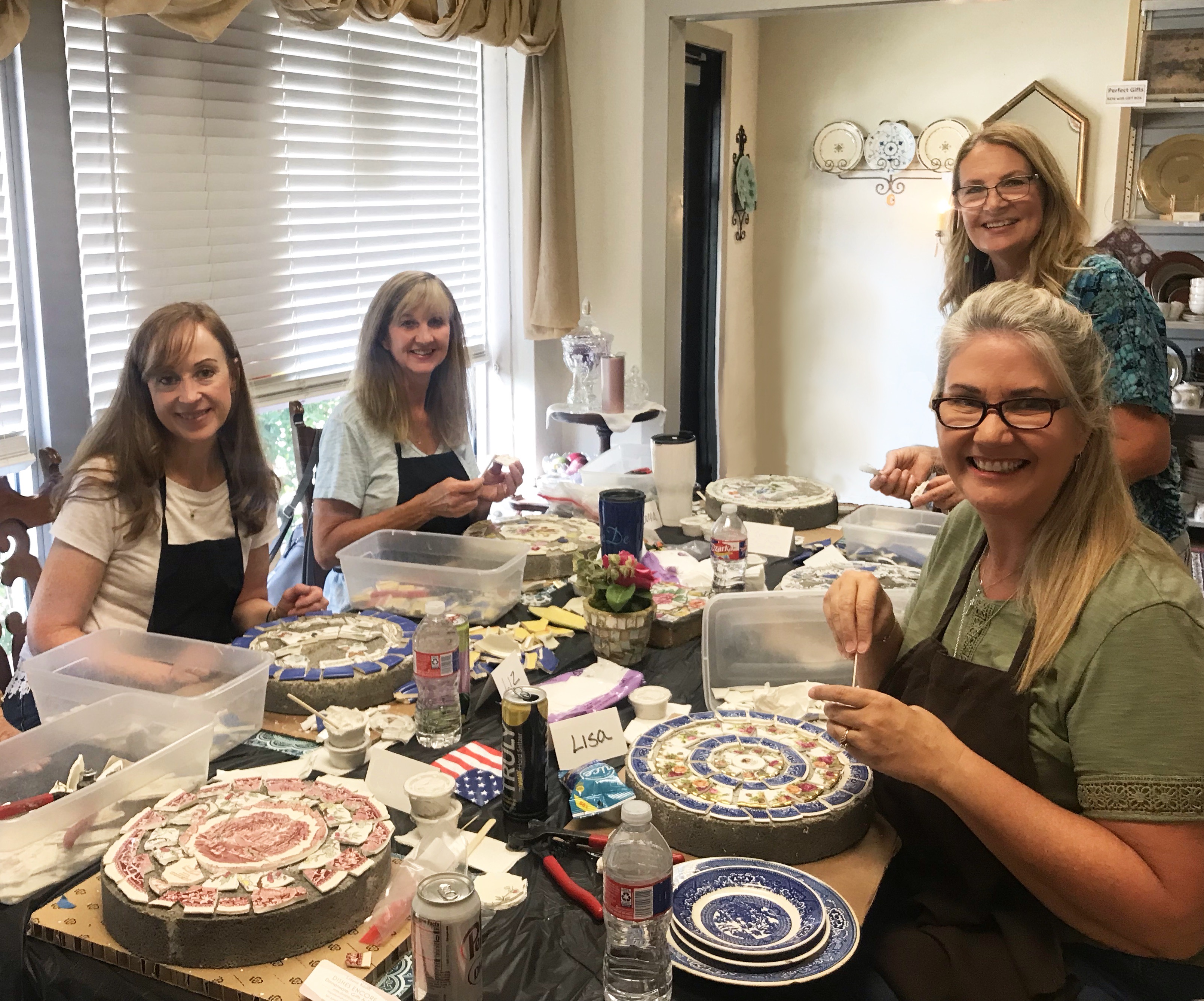
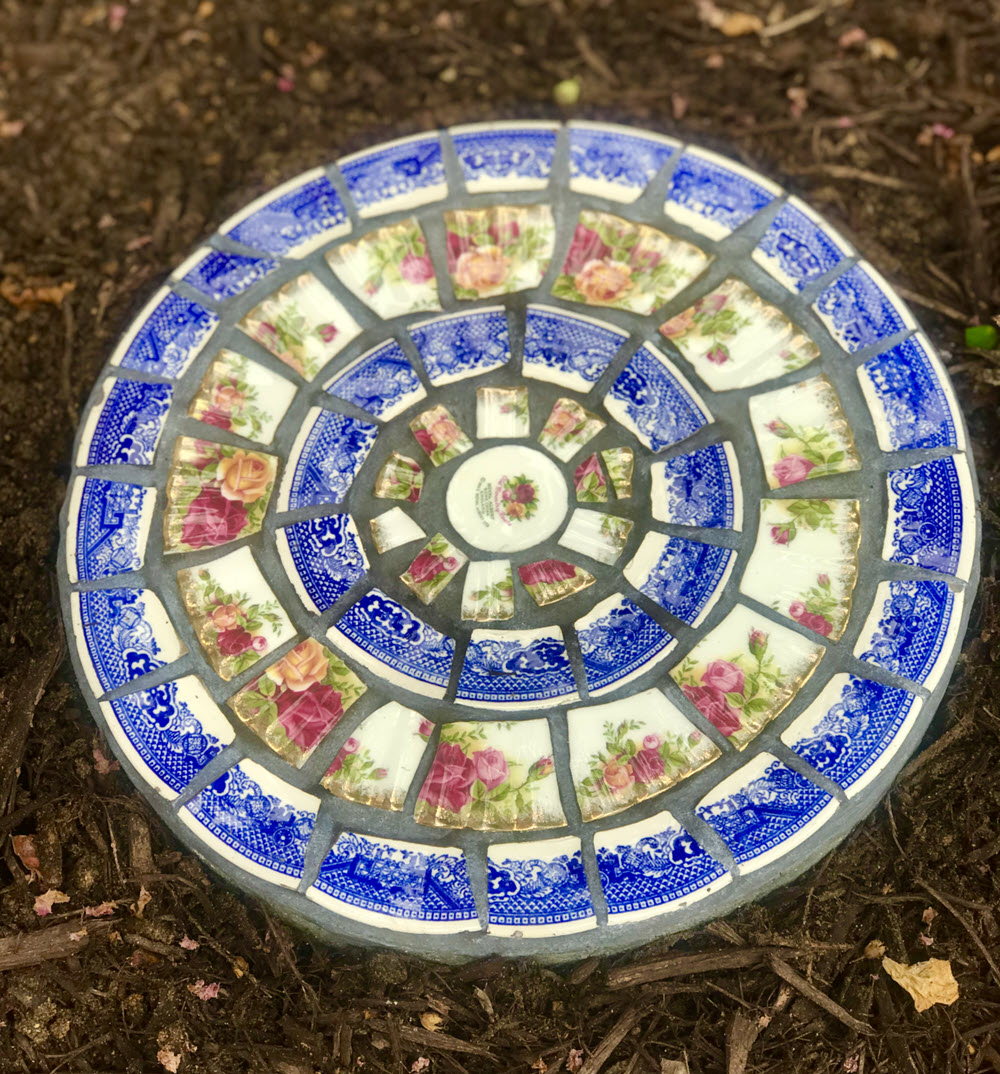
I’ve inherited a lot of sets of dishes, and I have three grown daughters, and so far there aren’t any takers. My friend Kim recently proposed the idea of taking a class to learn how to make mosaic stepping stones for the garden. I can’t think of a better way to downsize some of this china!
making mosaic tile stepping stones with my besties
So during last week’s live show (and you’ll find the link to the video replay here on YouTube in the video description below or go to genealogygems.com and click Elevenses in the menu to go to episode 64) I asked if any of you have family china:
Ann Baker: Inherited? No, but we have some wedding china from our wedding 52 years ago that our kids absolutely don’t want. I’m putting it in the will that they must keep them. Or I’ll haunt them.
Barbara Dawes: Wedding gift from my grandmother was my set of sterling silver – do I take it with me?
Anne Renwick: And yes, I have LOADS of old china!
Karen de Bruyne: had to give lots of grandparents old china away earlier this year, I kept one cup and saucer
Louise Booth: 3 or 4 sets — I’ve lost track!
mosaic tile stepping stone
China Plate Mosaic Stepping Stone Supply List (the links below are affiliate links. We will be compensated if you make a purchase. Thank you for using them and supporting this free show):
Concrete stepping stone from the local garden or hardware store
At least 2-3 large dinner plates or several smaller sizes. Strive for flatter plates.
Masonry cutters – ABN Glass & Ceramic Tile Nippers, Premium Carbide Cutting Wheels and Comfort Grip Handle
Grout Sealer (about 1/3 cup applied to the grout with a small paintbrush.)
2-3 popsicle sticks
Small cheap paint brush
Toothpick
Paper towels
Plastic gloves
China Plate Mosaic Stepping Stone Instructions:
Cut the plates up into piece 1-2” in size. Toss the pieces that aren’t fairly flat (like the raised rim that the plate sits on.)
Arrange them as desired on the concrete stepping stone. Place them as close as possible while leaving room for the grout. You don’t want large grout lines that might crack later.
Using the popsicle stick, apply a coat of mastic to the back of each piece. Cover the entire back evenly and press the piece back in place.
Clean up the grout lines so that no mastic sits higher than the plate pieces or clogs the grout line spaces.
Let drive 24 hours.
Mix the grout – use water sparingly and leave extra grout in case it gets too wet.
Let the grout stand or slake for 5 minutes.
Wearing the gloves and using a popsicle stick, fill all the grout lines completely and smoothly.
Follow package directions for set-up time and then buff it clean.
Allow to dry 24 hours.
With a small paintbrush apply the sealer to the grout lines and let dry.
Grandma’s Kitchen Utensils Wall Display
Do you remember spending time in your grandmother’s kitchen? I sure do. My maternal Grandma would take us out to the fields to pick fruits and vegetables and she canned a lot of it to preserve it for winter, keeping it in an old wooden pie safe in her garage.
I inherited many of her trusty kitchen utensils. I’ve hung on to them for years in a cardboard box, dragging them with me as we moved around the country. I’ve always wanted to display them but shelf and counter space is always so limited and precious. I needed a way to get them up on the wall and I finally found it.
When I was out shopping at an antique store I came across an old wire basket. It caught my eye because it wasn’t round. It’s rectangular shape turns into a hand display shelf when it’s turned on it’s side. Being wire, it’s not only easy to hand (place the bottom of the basket against the way and secure over a few good nails or hooks), but it’s the perfect canvas for displaying your utensils. Items can be placed on the “shelf” portion, and wired onto it from all directions. The nearly invisible wire means all you see is the beautiful patina of these old kitchen work horses – flour sifters, peelers, mashers, blenders, funnels and more!
Let’s hear from you: In the comments section tell us what your favorite family kitchen utensil is and who it originally belong to.
Watch Elevenses with Lisaepisode 27 on using Google Lens for genealogy.
Music Box: Name that Tune!
Now we’re going to start off with a little family history mystery that Sharon emailed me about
She writes: “I’m a long time listener and I’m loving Elevenses with Lisa! After watching Beginning German Genealogy, I remembered that my friend, Tera Fey, had shared a unique music box with me, hoping I could identify the tune. Tera had been given the music box by her grandmother, Cora (Cornelia?) DeWein, who had been given the music box by her grandmother from Germany. Tera remembers that the top used to have a crest attached to it but doesn’t remember what it looked like. I was hoping you could share the tune with your many listeners and perhaps someone could “Name That Tune”. Many thanks for the work you do and that you share with us.”
How fun! OK we’ve had success playing Name that Tune before on my Genealogy Gems Podcast so you’ve come to the right place Sharon!
So, here’s my research plan on Tera’s music box. The first thing I did after receiving her email was to put it out on the Genealogy Gems Facebook page asking for help a few months ago.
While I waited for an answer I ran a Google search on the audio, and if you ever need to identify music you can do this too.
How to search for music using the Google search app:
Open the app and tap the microphone
Say “what’s this song?” or tap the “Search a song” button.
Hum or sing the song for about 10-15 seconds.
This works in English on iOS, and in more than 20 languages on Android, as well as Google Assistant.
You’ll get suggested matching results or the response “Try Again”
In this case, we didn’t get a match.
Back on the Facebook post front, my daughter Lacey actually was the one who identified it as a Thorens Music Box, which are Swiss made. She said “Looks like 30-36 note? There would have been a card attached to the inside with the list of tunes. Looking at others for sale on eBay show similar boxes with their songs listed. Could listen to those songs to see if they match?” This is a good strategy.
A great place to listen to the songs available with a particular brand of music box is YouTube. I listened to several and although I didn’t hear a matching tune, there are many videos available naming the songs this box played, so it might be worth a more comprehensive search of Thorens Music Box.
Now it’s your turn. Let’s see if anyone out there knows the name of this song.
If you do, and you’re here watching live, post the title in the Live Chat. If you’re watching the video replay, go down to the Comments section and leave a comment. Let’s see if we can help Sharon and Tera out!
Help Send the Madden Family Tablecloth Back Home
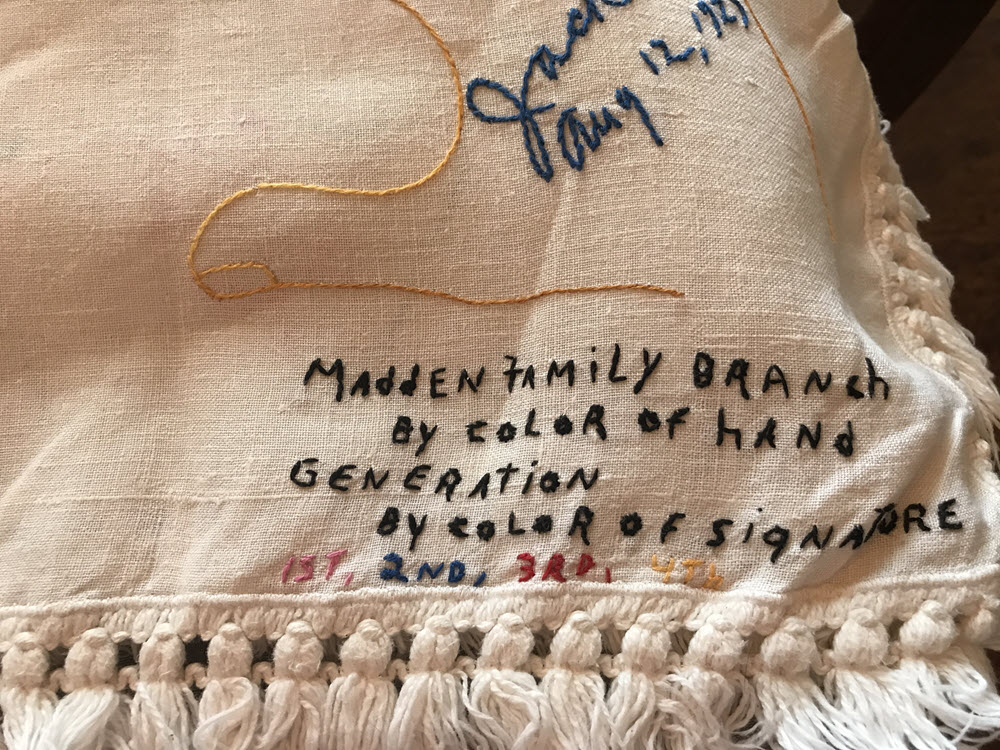
I bought this tablecloth about 5 years ago on ebay.com. It’s covered in embroidered handprints with names and birthdates. Since it’s the “Madden Family Branch” I would guess that those listed without last names are Maddens. Associated surnames are Egge and Arrants. Although a color key to the generations sewn into the corner of the tablecloth, there were other colors in the embroidery, so the “generation” distinctions aren’t hard and fast. I’ve also grouped families together where they appear to be a unit. If you think you know which family this is and have a contact for them today, email here.
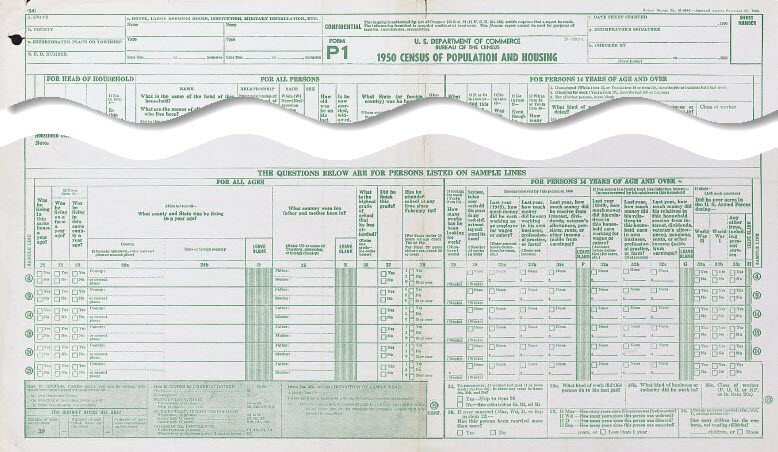
What questions were asked in the 1950 census? In this week’s video I’ll explain what was asked, and how the answers given can help provide clues for additional research about your family. You’ll also learn what was not asked and which questions were asked for the first time in 1950. Then we’ll wrap up with my Genealogy Pro Tip for the 1950 Census.
Episode 53 Show Notes
We’re all looking forward to the 1950 census coming out in April 2022, followed soon after by the searchable index. But before we dig into it, it’s helpful to know what kinds of questions were asked and what kind of information you can expect to find about you, your parents, your grandparents or even your great grandparents.
If you haven’t watched it already, check out Elevenses with Lisa episode 51 for an overview of the 1950 census.
And I’ll have that video link for you again at the end of this video. And of course the best way to find your own genealogy gems is to follow my genealogy gems channel, so click the YouTube Subscribe button and that will toss me and this channel into your favorites list on YouTube for safe keeping and happy viewing for years to come.
The U.S. Federal Census is taken every 10 years here in the United States. Typically in genealogy we see more and more questions being asked each decade, which is awesome for us as family historians. But did you know that the 1950 population questionnaire actually asked FEWER questions than its predecessor in 1940.
Yep, according to the U.S. Census bureau, in 1940 every household was asked 34 questions. However, in 1950 they were asked just 20 questions. As we go through the questions I’ll let you know what’s the same, what unfortunately you will NOT being seeing, BUT also the few NEW questions that were asked.
Questions Asked on the 1950 U.S. Federal Census Questionnaire
The following questions were asked of everyone in the household.
1. Name of street, avenue or road where the household is located
2. Home or apartment number
3. Serial number of dwelling unit
4. Is this house on a farm (or ranch)?
5. If no, is this house on a place of three or more acres? (New question for 1950 thanks to the expansion of suburbia.)
6. Corresponding agriculture questionnaire number
7. Name
8. Relationship to head
9. Race
Census takers were instructed to assume that all members of the related household were the same race. For unrelated people they were to ask. And if you see a description you are unfamiliar with, consult the 1950 census enumerator instructions.)
10. Sex
11. How old was this person on his last birthday?
It was expected that there would be some folks who either didn’t know their exact age or didn’t care to share it. Census takers were instructed to try to zero in and get as accurate as possible. If age wasn’t known, they were instructed to enter an estimate as the very last resort, and footnote that it was an estimate.
12. Is this person now married, widowed, divorced, separated, or never married?
Marriage codes found in this column:
MAR = married
WD = widowed
D = divorced
SEP = separated
NEV = never married. People under the age of 14 were automatically labeled as never married. Also, common-law marriages were reported as Married, so while marital status can be an indicator to look for marriage records, it is possible that there may not be any.
13. What State or country was the person born in?
It’s important to note that if the baby was born in a hospital across the state line, they were reported as being born in the state where the family lived. This is important to keep in mind when hunting for birth certificates.
14. If foreign born, is the person naturalized?
This will be a yes or no. But if you see “AP” it means the person was born of American parents abroad or at sea. Also, if born at sea they were an American citizen if their father was, or if they were born after 5/24/1934 and either parent was American.
Before we get to the last six questions which were asked only of people 14 years of age and older, let’s take a look at the questions you might have expected to see that were asked in the previous 1940 census but were not.
Questions Not Asked in the 1950 Census that Were Asked in 1940
These questions include:
Home owned (O) or rented (R)
Value of home or monthly rental if rented
Attended school or college at any time since March 1, 1940?
Highest grade of school completed
Residence, April 1, 1935
City, town or village having 2,600 or more inhabitants. If less, enter “R”
County
State (or Territory or foreign country)
Farm?
Questions Asked in the 1950 Census of People Over the Age of 14
You may be wondering why the last 6 questions of the 1950 census were only asked of people over the age of 14. It’s because these questions were about employment status. Not surprisingly, these questions vary a bit from what was asked about in employment in 1940, but they are pretty similar.
What was this person doing most of last week – working, keeping house, or something else?
Employment Codes used in questions 15:
WK = working
H = keeping house
U = unable to work
OT = other
16. If the person was “keeping house” or “something else” in question 15, did the person do any work at all last week, not counting work around the house? (Including work-for-pay, in his own business, working on a farm or unpaid family work)
17. If the person answered “no” to question 16, was he looking for work?
18. If the person answered “no” to question 17, even if he didn’t work last week, does he have a job or business?
19. If the person was working, how many hours did he or she work in the last week?
20. What kind of work does the person do?
What kind of business or industry is the person in?
Class of worker the person is.
Enumerators were to mark “P” for private employment, “G” for government employment, “O” for own business, or “NP” for working without pay
Here’s an example of an entry you might see for someone’s employment: Jewelry, Salesman, P. Armed forces was used for all types of military service.
The one glaring omission in 1950 is questions about whether the person worked for one of the government program such as the Works Progress Administration known as the WPA or The Civilian Conversation Corp known as the CCC. This actually makes sense because these employment programs were focused on helping the unemployed during the Depression. WWII had most Americans working and doing their part in some fashion creating low unemployment. Therefore, the WPA was ended in 1943.
Genealogy Clues in the 1950 Census
Let’s quickly recap what you will learn from the answers to the questions asked during the 1950 census that can help you learn more about your family history:
You’ll see the names of your relatives and ancestors, where they lived and the relationships within the family.
You’ll find out where they were living and get the actual address. You can then use this information to find old maps, search city directories and learn much more about their neighborhood and their lives.
If your relatives lived on a farm you’ve got another genealogy gem to find which is their listing in the Agricultural census. Remember the population enumeration, the one counting people, is just one of the enumerations that was conducted. The 1950 population enumeration will give you the number where you can locate them in the agricultural questionnaire.
You’re also going to learn your relative’s age which will get you even closer to determining their birthdate. This in turn will help you locate their birth records. You will also learn the state or country where they were born.
If they were foreign born you will find out if they were naturalized. It’s a little disappointing that it doesn’t tell us the year of immigration or naturalization. However, a “yes” in the “is the person naturalized” column does provide you with an excellent clue to go look for those naturalization records. Learn more about finding and using naturalization records for genealogy in my FamilyHistory: Genealogy Made Easy podcast:
Episode 29: Immigration and Naturalization Records for Family History, Part 1.
Genealogy lecturer and blogger Stephen Danko, PhD, begins a 3-part series on U.S. immigration and naturalization records. Learn about passenger arrival lists in the U.S., little-known certificates of arrival and naturalization records: how to find them and what’s in them.
And finally, you’ll not only find out if they were married and if they had any previous marriages.
Lisa’s Pro Tip for the 1950 U.S. Census
After my first video on the 1950 census I got this question from Suzanne: Will the 1950 census also have the children born to mother/children still living question?
The answer is, maybe.
Pro Tip: Keep an eye out for additional questions.
As in 1940, 5 percent of the population were asked an additional slate of questions. This was to provide sample data about the population. One of those questions asked was “If female and ever married, how many children has she ever borne, not counting stillbirths?”
Supplemental Questions Asked in the 1950 Census
Here are the additional questions that were asked of just 5% of the population in the 1950 U.S. Federal Census. (Note: They were asked of all ages.)
21. Was the person living in the same house a year ago? If the answer was no, then…
22. If no to question 21, was the person living on a farm a year ago?
23. If no to question 21, was the person living in the same county a year ago?
24. If no to question 23…
What county (or nearest place) was he living in a year ago?
What state or foreign country was he living in a year ago?
25. What country were the person’s mother and father born in?
26. What is the highest grade of school that the person has attended?
Enumerators were to mark “0” for no school; “K” for kindergarten; “S1” through “S12” depending on the last year of elementary or secondary school attended; “C1” through “C4” depending on the last year of undergraduate college education attended; or “C5” for any graduate or professional school.
27. Did the person finish this grade?
28. Has the person attended school since February 1st?
Enumerators could check a box for “yes” or “no” for those under thirty; for those over thirty, they were to check a box for “30 or over.”
For members of the household who were 14 years and older, they also answered these questions centered around employment details, money, military service previous marriages and the question Suzanne is hoping to have answered – children born to women in the household.
1950 census supplemental questions asked of 5% of the population.
29. If the person is looking for work, how many weeks has he been looking for work?
30. Last year, how many weeks did this person not work at all, not counting work around the house?
31. Last year, how much money did the person earn working as an employee for wages or salary?
32. Last year, how much money did the person earn working at his own business, professional occupation, or farm?
33. Last year, how much money did the person receive from interest, dividends, veteran’s allowances, pensions, rents, or other income (aside from earnings)?
34. If this person is the head of the household: last year, how much money did his relatives in this household earn working for wages or salary?
35. If this person is the head of the household: last year, how much money did the person earn working at his own business, professional occupation, or farm?
36. If this person is the head of the household: last year, how much money did the person receive from interest, dividends, veteran’s allowances, pensions, rents, or other income (aside from earnings)?
37. If male: did he ever serve in the U.S. Armed Forces during…
World War II
World War I
Any other time, including present service
38. To enumerator: if the person worked in the last year, is there any entry in columns 20a, 20b, or 20c?
39. If yes, skip to question 36; if no, make entries for questions 35a, 35b, and 35c.
What kind of work does this person do in his job?
What kind or business or industry does this person work in?
Class of worker
40. If ever married, has this person been married before?
41. If married, widowed, divorced, or separated, how many years since this event occurred?
42. If female and ever married, how many children has she ever borne, not counting stillbirths?
The 1950 U.S. Census – A Valuable Genealogical Record
So now you know all the details on what you can look forward to learning about in the 1950 census. If you would like to learn more about the 1950 census, watch The 1950 Census for Genealogy. You can watch the video and get the complete show notes here.
WATCH NEXT: episode 51 and get the show notes here.
Yakety Yak – Talk Back in the Comments
Elevenses with Lisa is a genealogy community, and discussion is a big part of the experience. In the Comments below please share on one of these topics:
What question are you most looking forward to getting an answer to in the 1950 census?
Who you’re hoping to find in the 1950 census?
What question do you have for me about the 1950 census?
Elevenses with Lisa is our little slice of heaven where friends get together for tea and talk about the thing that never fails to put a smile on our face: Genealogy!
Are you ready for a year of successful genealogy? Learn how to develop an effective research plan, and preserve and protect your genealogy. Keep reading for the show notes that accompany this video.
10 Questions to Rate Your Readiness for Genealogy Success
1. Have you selected a place to start?
I started learning how to play the guitar in 2020. I began with an online course to learn the basics, and I picked one song that I really wanted to learn how to play.
For three months I worked my way through the course and played that song over and over every day. This resulted in two things: I learned how to play the song, and my husband took a blow torch to my guitar! (Just kidding.)
At the end of those three months I had several weeks where I just didn’t feel I was making any progress at all. I practiced every day, but I wasn’t getting anywhere.
It turns out that I had reached my initial goals – I knew the most popular chords, had memorized the Pentatonic Scale and could play the song Crazy On You for a captive audience in my home. However, I had not stopped to identify my next set of goals. Therefore, stagnation set in.
In an effort to restart my learning and success trajectory, I spent an evening looking through my record collection and I made a list of 6 of my favorite songs. Then I put them in the order I wanted to learn to play them. Most importantly, I identified which one was my top priority to learn. Once I did that, I knew exactly how I was going to spend my practice time.
It sounds simple, but finding and deciding on the place to start (or restart) is really easy to miss. When it comes to genealogy there’s always a bright shiny object online ready to gobble up a few precious minutes, or hours, or days! Having a predetermined project goal in mind will help you get down to business faster and keep you from wandering aimlessly.
2. Have you developed a project research question?
Once you know what your project will be, it is time to formulate the general question. In other words, what is the question you are trying to answer?
In this episode I shared the family story that had been handed down the McClelland family about their ancestor Washington McClelland. The story went like this: “He immigrated to the U.S. from England. He was working on the railroad when he met a girl in Idaho. She became pregnant. They married. He converted to the LDS church. They raised a family together.”
The general research question was “is this story true?” That’s a big question, and one that we’ll break down further in question #3.
Genealogy Gems Premium Members can learn more about formulating research questions by watching the segment HowAlice the Genealogist Avoids the Rabbit Hole Part 1 in Elevenses with Lisa Episode 2. It’s available in the Premium Videos area of the Genealogy Gems website. Don’t miss the downloadable handout! You’ll find the link under the video. (Learn more about becoming a Premium Member here.)
3. Do you have a Research Plan for your genealogy project?
The general project question can usually be broken down into several bite-sized actionable questions. In the example of “Is the story about Washington McClelland true?” we can break that question down into several questions:
Where exactly was Washington from in England?
When did he come to the United States?
Why/how did he end up out West?
Did he work on the railroad?
When and where did he marry?
When was their oldest child born?
Did he join the LDS church?
And many of these questions can likely be broken down further. These more focused question help provide the framework for the project’s research plan. They can then be re-sorted so that they follow a logical progression of answers.
The next step will then be to identify and prioritize the sources (records) that are likely to provide the necessary relevant evidence. Then determine the order in which you will locate each identified record. Finally, add where you think you can find the records to the plan.
4. Do you have the research forms you need?
There are many different types of genealogy research forms: research logs, blank record forms, checklists, just to name a few.
Research logs are great for keeping track of your research plan progress. Blank record forms (such a blank 1900 U.S. Federal Census form) are very handy for transcribing the pertinent information for analysis. And checklists (such as a list of all types of death records) help ensure that you don’t miss and records, and you don’t look for the same record twice!
Free Genealogy Forms at Family Tree Magazine
Family Tree Magazine offers a plethora of free genealogy forms. You’ll need to register for a free website account to download the forms.
Having an organizational system in place takes the guesswork out of where things should be filed, making it much more likely they will actually get filed. It also ensures that you’ll be able to put your hands on your records whenever you need them.
Here’s a secret: There is no one perfect filing system. The most important thing is that it makes sense to you and that you are consistent in how you use it.
In Elevenses with LisaEpisode 6 (available to Premium Members) I cover step-by-step the system I developed and have used for over 15 years. I’m happy to report I’ve never lost an item. (Whew, what a relief!)
As you work on your genealogy research you’ll find there are two important tasks you will be doing often:
Storing items that you have not had a chance to work on yet (I refer to these pending items as “to be processed.”)
Storing items that need to be filed. (Let’s face it, we rarely want to stop in the middle of an exciting search to file a document.)
Not having a way to store these two types of items leads to clutter and piles on your desk. Here’s my simple solution:
Place a “to be filed” basket next to your desk.
Create a “Pending” tab in each surname 3-ring notebook (if you use my system.) The beauty of the surname notebook Pending section is you have a place to put documents (out of sight) that are associated with a specific family. When you’re ready to work on that family line, grab the notebook and jump to the Pending section to start processing and analyzing the previously found records.
7. Do you have the supplies you need on hand?
Make sure that you have a small quantity of all of the supplies you need for the filing and organization system you are using.
Here’s what my shopping list looks like:
3” 3-Ring View Binders
(allow you to customize covers & spines)
1” 3-Ring View Binder
1 box of Acid-Free Sheet Protectors
3-Ring Binder Tab Dividers
8. Have you settled on a file naming scheme?
How to name digital genealogy files is something we all struggle with. Good intentions don’t make the job any easier. Take a few moments to nail down the basic naming scheme you will commit to follow. I say basic, because there will be times when you’ll need to modify it to suit the file. That’s OK. But always start with the basic format.
Here’s what my basic file naming format looks like:
Year (will force chronological order)
First Name (filed in surname folder)
Location
Example: 1920_robert_m_springfield_oh
Notice in my format I don’t usually include the surname. That’s because I file in surname folders. Notice that I said “usually.” That’s because we are always free to add on additional information like a surname if we think it will prove helpful. For example, if I anticipate that I will have a need to share individual files with other researchers or family members (rather than the entire folder) then I will add the surname so that the person receiving the file has the pertinent information.
8. Are you prepared to make copies?
Protecting and preserving our genealogy for generations to come is a top priority for most genealogists. All of us at some time have worried about what would happen if a website that we upload our content to goes out of business or sells out to another company. Now there is a new reason to take a few extra steps to ensure you don’t lose access to your genealogy data.
Recently, According to Buzz Feed, on Jan. 9 the largest cloud-hosting service notified a large social media network with millions of users that it would be cutting it off from its cloud hosting service. According to the Wall Street Journal, “other tech partners also acted, crippling operators.”
Now we must add to the list of concerns the possibility that a genealogy website we use might be cut off from web hosting. How might this type of action impact our personal family history that we share on websites? Many companies that provide access to millions of historical records and likely house a copy of your family tree and your DNA test results use the same cloud hosting service. In fact, it’s hard to find a company out there that isn’t tethered to it in some way.
My research showed that both Ancestry and FamilySearch have been featured on their website in case studies and blog articles:
The bottom line is that our family history is our responsibility to preserve and protect. While we can benefit from sharing copies of it online, putting all our genealogy eggs in only the online basket puts it at risk because we don’t have control.
While I love the idea of going paperless and I’ve been striving to do that in recent years, I’m changing my tune on this. For several years I’ve been strongly recommending that you get your own genealogy software on your own computer and use it as your master database. All online family trees are simply copies. Many people, particularly those who rely solely on FamilySearch often wondered why I was so concerned. The events of this week make my point and put an exclamation point on the end of it.
Making digital and paper copies of your data is a simple strategy you can put in place today. This means regular print outs of your tree, family group sheets, and the most important genealogical documents. I keep mine in a portable fireproof safe.
We can also make digital copies as well. For example, last year I had all my old home movies transferred to digital and they are stored on my computer. I went the extra step to get copies on DVD and I also copied the digital files onto a terabyte hard drive that is in the fireproof safe.
Remember, your computer is connected to the Internet. If you’ve ever woken up to a Windows update, then you know that tech companies can make changes to your computer. Having your own paper and digital copies are just extra insurance that certainly can’t hurt.
Here’s a checklist of things you can put in place today:
a good printer
extra ink
a stock of paper
a portable terabyte hard drive
Ideas for saving paper and ink:
Print only the most important documents that might be more difficult to replace.
Focus your printing on direct ancestors.
Print in draft mode (depending on the document) and / or black and white to save ink.
Make double-sided copies.
When possible, add two documents to each side of the paper so that one piece of paper holds 4 documents.
9. Is your computer backed up to the Cloud?
I use and recommend Backblazefor computer cloud backup. They have their own storage facility. Here’s what their storage pods look like:
Image courtesy of Backblaze.
I am also an affiliate of Backblaze so I appreciate when you use my link if you decided to make a purchase. I will be compensated at no additional cost to you, and that supports this free show. https://www.backblaze.com/landing/podcast-lisa.html
Learn more: Premium Members can watch the Premium video Your Guide to Cloud Backup and download the PDF handout. You’ll get answers to questions like:
What is cloud backup?
Why should I use cloud backup?
How does cloud backup work?
Is cloud backup safe?
What should I look for when selecting a cloud backup service?
My personal cloud backup choice
10. Have you scheduled ongoing education time?
Pick one area you want to improve your genealogy skills and knowledge and make time each week to learn something new about it.
Thank you for making Elevenses with Lisaand Genealogy Gems one of your places for genealogy learning, laughing and getting refilled!
Use a free service like Blogtrottr.com to receive email notification reminders. Simply paste the Genealogy Gems channel URL into the first field, https://www.youtube.com/GenealogyGems enter your email address and select from the drop-down menu how often you would like to receive notifications. Then click the orange “Feed Me” button. When I post a new video or schedule an Elevenses with Lisa episode you’ll receive an email notification.
Recap:10 Questions to Rate Your Readiness for Genealogy Success
Have you selected a place to start?
Have you developed a project research question?
Do you have a Research Plan for your genealogy project?
Do you have the research forms you need?
Have you established Your Filing System?
Do you have the supplies you need on hand?
Have you settled on a file naming scheme?
Are you prepared to make copies?
Is your computer backed up to the Cloud?
Have you scheduled ongoing education time?
Elevenses with Lisa Archive
Premium Member have exclusive access to all of the archived episodes and downloadable handouts. Visit theElevenses with Lisa Archive.
Let us know if you found this video and article helpful. I’d also like to hear from you about the topics you would like to learn more about in future episodes. Thanks!